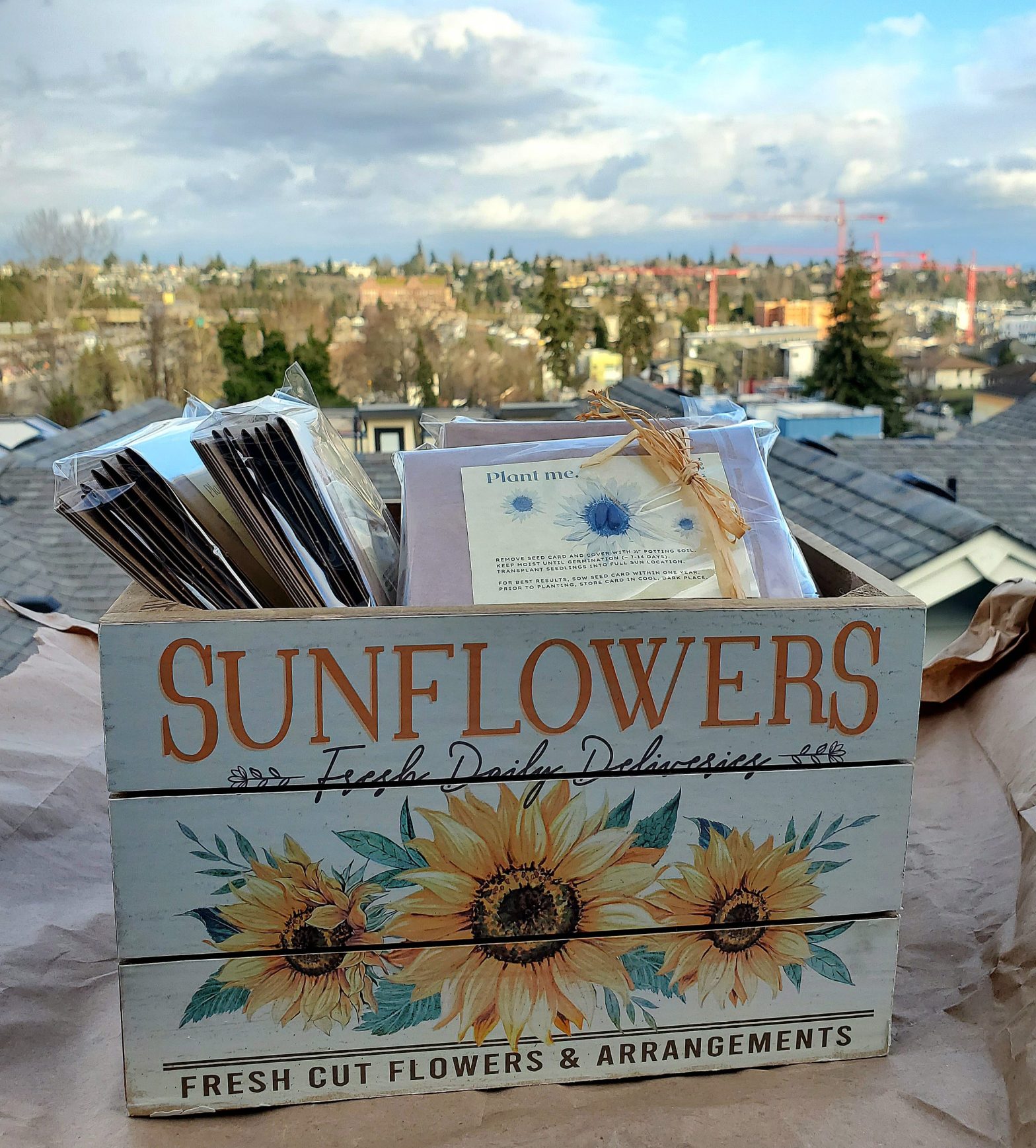
Did you know that the average growing period for most sunflowers (Helianthus annuus) is 85 – 95 days? (This also happens to be a little shorter than the duration between today and November 5, 2024, the date of our next presidential election). If you’d like to grow good things for our community this season, there’s still time – scroll to the bottom of this page for details on getting your free sunflower seed card.
For many, sunflowers are a symbol of resilience. Even in the poorest of soils, these picturesque plants rise up and bloom, turning toward the light each morning through a process known as heliotropism. Sunflowers are native to North America but due to the demand for sunflower oil in Europe, they’re known widely as a popular commercial crop especially in Ukraine (my great-grandfather’s home country).
Sunflowers have had a place in my edible garden since the earliest days at our Portland, Oregon farm. I continued growing sunflowers on our Beacon Hill townhouse rooftop, in my Seattle p-patch plot, and now along our NE Portland backyard fence. Summer isn’t complete without a sunflower patch tucked somewhere within my current growing space. Read more about my love of sunflowers here.
Sunflower seeds, when collected and stored properly, remain viable for quite a while – even up to 5-7 years in optimal conditions. I created this current batch of sunflower seed cards during the winter of 2022, as a therapeutic horticulture pandemic project, from sunflowers grown in our rooftop garden the previous summer. In periodic germination tests (the most recently, in June 2024), the germination rate for each two-seed sunflower seed card consistently ranges from 50% – 100%. I’m pretty confident that many of these cards will bloom this season. And I’d like to share as many as possible with you. Likely, we’ll all benefit from such botanical pick-me-ups to help us cope and maintain hope, in the coming months.
Stay tuned for more ways to get free seed cards, but here’s a few:
- Visit the Beacon Hill Garden Club Share at El Centro de la Raza from 10am – 2pm on August 10th
- If you belong to a Pacific Northwest non-profit, educational, or community organization, please email me at lavenderbellefarm@gmail.com.
- Send a self-addressed, stamped envelope to Attn: Lavender Belle Farm, P.O. Box 13514 Portland OR 97213, by August 15th, and I’ll drop several seed cards in the mail. U.S. only, please.


 Lavender Belle Farm